
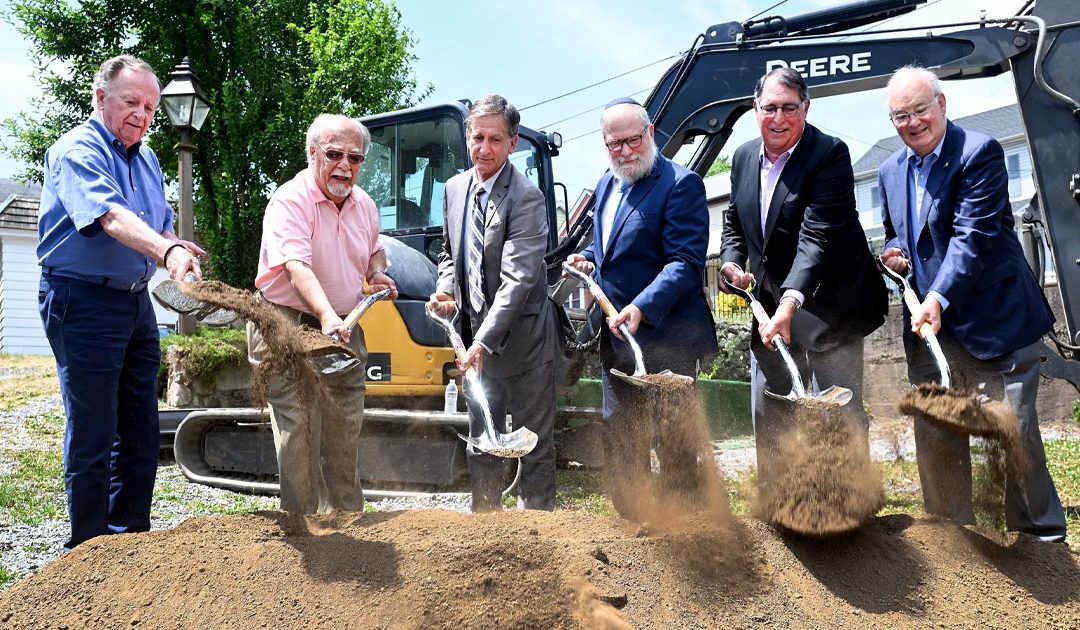
Three years ago on a hot Thursday in July, a group of people led by state Rep. Mark Gillen gathered outside the Berks Military History Museum in Mohnton.
Local lawmakers, members of the business world and community leaders grabbed ceremonial shovels and tossed dirt onto a newly planted birch tree. The ceremonial act served two purposed: to dedicate the plant as the Jakob Silberstein and Jana Sudova Memorial Birch Tree and as a groundbreaking for an addition to the museum.
During that event, Gillen, the museum’s founder, shared a vision of creating a Holocaust museum that would sit right beside the military history museum.
It was a plan, he admitted, that would be difficult to accomplish. For starters, none of the more than $2 million needed at that time to build the addition had been raised.
And since the military museum, which has operated since its opening in 2017 based solely on the efforts of volunteers, doesn’t charge admission or sell anything, scrounging up that big a stack of cash was going to be an enormous challenge.
“It’s going to take a miracle,” he said at the time.
On Thursday, a day just as hot as the one three years ago, another group gathered at the site. Many of the faces were the same, but the reason for them being there was slightly different.
This time around, they were celebrating the miracle that Gillen was counting on coming true.
A little more than $2.5 million has been raised for the project, with another $1 million or so committed. The addition has been designed and received approval from the borough, and actual construction is about to start.
That meant it was time for another groundbreaking ceremony, and not just an aspirational one this time.
“It’s really going to happen,” Gillen said shortly before starting the ceremony, a smile that hinted at both happiness and relief stretched across his face.
Gillen began Thursday’s ceremony harkening back to the first version back in 2021, recalling picking up shovels similar to the ones sticking out of a pile of dirt a few feet away. He said that during that event members of the media asked how much money he had for the project.
“I said we have no money,” he said, adding that he believed the community would rally behind the project. “We had no money, but we had a purpose. We had a heavenly call.”
Gillen’s prediction came true. Over the past three years the community has, indeed, thrown its support behind the project and provide enough funding to make it a reality.
“It’s pretty important to the community,” he said. “But the community also decided this was important enough to invest in.”
And, Gillen said, now is the perfect time to be moving forward with the museum. He said there has been a rise in antisemitism around the country and pointed out that there are many Americans who believe the Holocaust was a hoax.
That was made clear to him when he first announced the Holocaust museum project. He said he received letters and read comments on online news stories that were filled with hateful, offensive rhetoric.
People wrote that the Holocaust is a lie, they drew swastikas, the wrote phrases like “sieg heil.”
“I don’t know if there’s a more important time for education than now,” he said.
And the museum, he said, will do just that. Gillen said planning for the interior of the facility — details about the artifacts and displays — has begun. Officials from the Holocaust Awareness Museum and Education Center in Philadelphia have pledged to provide items on permanent loan, and Gillen said other artifacts are being purchased or donated.
Gillen said he imagines the museum as an immersive experience, one that will inspire meditation and reflection. And, he said, he hopes to be able to provide an experience unlike similar museums.
“We want to tell some stories people might not be as familiar with,” he said, adding that creating what’s inside the museum may end up being an even bigger job than getting it built. “We have some pretty wild ideas.”
Gillen said construction is expected to take about a year. The addition will double the size of the current museum to a total of about 9,000 square feet.
The Holocaust museum will be next to the current building at 198 E. Wyomissing Ave., with a shared elevator providing access to both structures.
Others who spoke during Thursday’s ceremony expressed excitement to see the project come to fruition, many echoing Gillen’s statements about the need for Holocaust education.
“I think recent events have shown us all the more vividly why this is needed,” Michael Duff, vice president of community engagement at Penske Truck Leasing said, referencing the Oct. 7 attack by Hamas terrorists on Israel and recent anti-Israel protests on college campuses.
Duff said that for a long time he held the naive belief that antisemitism was dead. It’s clear now, he said, that he was wrong.
With much of the antisemitic rhetoric he is hearing sounding eerily familiar to the rhetoric of the Nazis, Duff said it is a crucial moment to educate the public.
“It has to be stopped in its tracks,” he said.
Rabbi Yosef Lipsker, founder and director of Chabad Lubavitch of Berks County, said he understands comparisons to the days of the Nazis. But, he added, there’s one important thing that’s not the same.
“What’s different today than 1938, 1939?” he asked. “What’s different?”
The answer, he said, is clear when he looks around at the people gathered for the event. It wasn’t an overly Jewish crowd, he said, instead made up of what he called “righteous gentiles” who care about justice for all humanity.
That support from the non-Jewish world didn’t exist in pre-World War II Germany, he said, but clearly does in Berks County in 2024.